
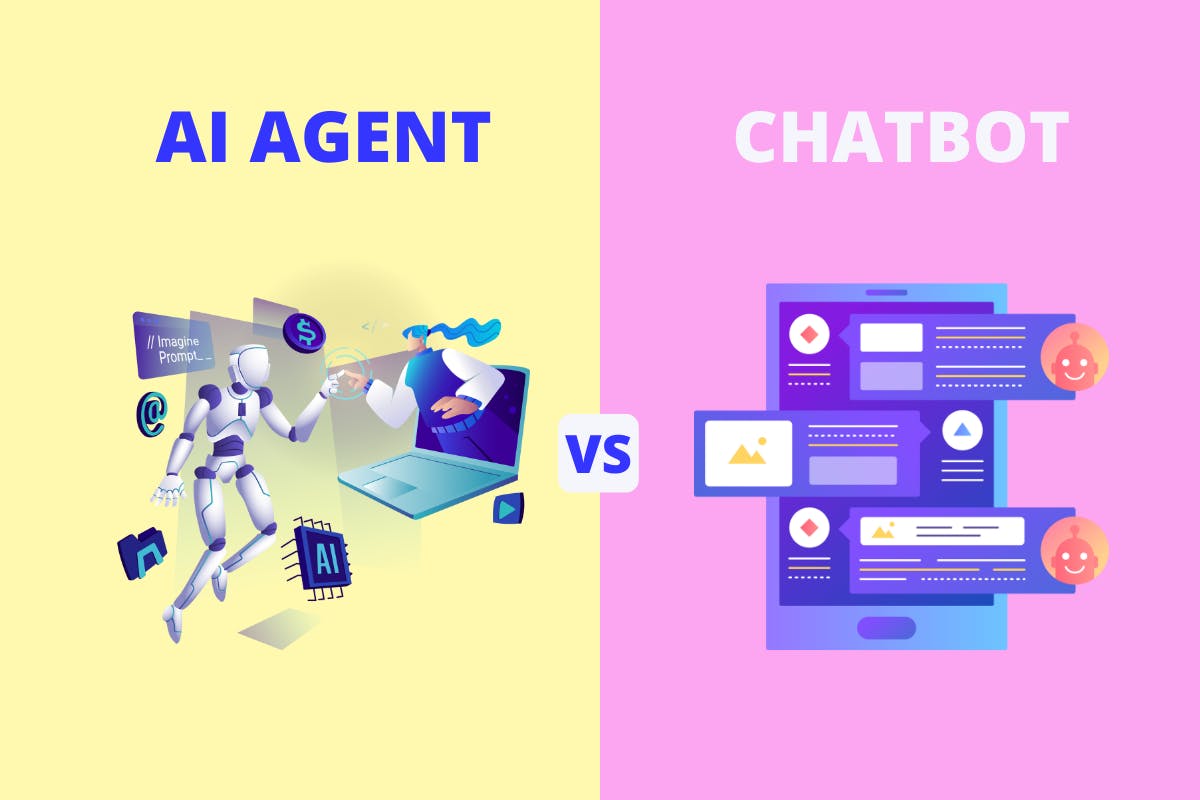
The biggest difference between a chatbot and an AI agent is that chatbots are designed to answer questions, while AI agents are designed to take action and complete tasks.
A chatbot typically responds to user messages within a conversation. An AI agent can understand goals, make decisions, use tools, interact with software, and carry out multi-step workflows with minimal human input.
As AI becomes a bigger part of how businesses operate, understanding this distinction is increasingly important for anyone interested in automation, software development, entrepreneurship, or AI careers.
In this guide, we'll break down the differences between chatbots and AI agents, explore real-world examples, and explain why AI agents are becoming one of the most important technologies in modern business.
AI Agents vs Chatbots at a Glance
Category | Chatbot | AI Agent |
Primary Purpose | Answer questions | Complete goals and tasks |
Behavior | Reactive | Proactive |
Decision Making | Limited | Advanced |
Memory & Context | Short-term | Can maintain context across tasks |
Tool Usage | Usually none | Can use APIs, databases, and software tools |
Task Complexity | Simple interactions | Multi-step workflows |
Learning & Adaptation | Limited | More adaptive |
Example | FAQ bot, customer support bot | AI assistant that schedules meetings and generates reports |
What is a Chatbot?
Simple Definition and Analogy
A chatbot is a program that simulates human conversation. Think of it as a digital receptionist — great at answering FAQs, booking appointments, or retrieving simple info.
How Chatbots Work
Modern chatbots may use large language models (LLMs) to generate more natural responses, but their primary role remains the same: responding to user questions and requests within a conversation.
Most chatbots are designed to react to inputs rather than independently pursue goals or execute complex workflows.
Where Chatbots Are Used Today
- Answering customer service FAQs
- IT helpdesk bots
- Booking and reservation systems
- Internal company knowledge assistants
Limitations of Chatbots
- Can’t handle complex questions
- Often give rigid, robotic answers
- Break when users go off-script
- Reactive — they only respond to inputs, never act on their own
What is an AI Agent?
A More Advanced Digital Assistant
An AI agent is like a smart intern, virtual coworker, or autonomous collaborator. It doesn’t just respond — it thinks, reasons, learns, and takes action.
How AI Agents Work
AI agents are powered by advanced machine learning models, often using LLMs like GPT. They can understand context, adapt to feedback, and interact with multiple tools and systems. Instead of following a script, they follow goals.
They can:
- Plan multi-step tasks
- Make decisions
- Learn from new data
- Adapt based on changing inputs
- Integrate with APIs, tools, and databases
Real-World Use Cases for AI Agents
AI agents are already transforming work across industries:
- Marketing: Writing emails, managing campaigns, tracking performance
- Customer Success: Handling nuanced B2B support across channels
- E-commerce: Managing inventory, order flows, and personalized recommendations
- Career Coaching: Assisting with job applications, resume generation, and interview prep
- Vacation Rentals: Automating guest messaging, pricing, and booking logistics
- DeFi & Finance: Monitoring data feeds, executing trades, sending alerts
Why AI Agents Are a Game-Changer
AI agents operate like autonomous systems. They don’t just respond to prompts — they solve problems end-to-end, even when the tasks are complex or span across platforms.
Read further: What are AI Agents?
Examples: Chatbot vs AI Agent
Consider a customer support scenario.
Chatbot
A customer asks:
"Where is my order?"
The chatbot checks an order status database and returns a tracking update.
AI Agent
A customer asks:
"My package hasn't arrived and I need it before Friday."
The AI agent can:
- Check the order status
- Review shipping options
- Contact logistics systems
- Upgrade shipping if permitted
- Notify the customer of the resolution
Instead of simply answering a question, the AI agent works toward a goal and takes action across multiple systems.
Do AI Agents Replace Chatbots?
Not necessarily.
Chatbots are still the best solution for many simple tasks such as answering FAQs, booking appointments, or handling basic customer support requests.
AI agents become valuable when tasks require reasoning, decision-making, tool usage, or multi-step workflows.
In many businesses, chatbots and AI agents work together rather than replacing one another
Why This Difference Matters for Aspiring AI Professionals
Choosing the Right Tool When Building AI Solutions
If you're learning AI to build real-world solutions, you’ll need to understand when a simple chatbot is enough — and when only an intelligent, autonomous agent will do the job. Choosing the right architecture means the difference between building something people use vs. something people love.
Career Implications: What Employers Are Looking For
Companies aren’t just looking for chatbot builders anymore. They're hiring people who can:
- Design intelligent workflows
- Automate decision-making processes
- Build tools that actually solve complex problems
Knowing how to build or deploy AI agents gives you an edge in a crowded job market.
The Future of Work Is AI-First
As businesses shift toward AI-first operations, the demand is exploding for people who can design, coach, and deploy AI agents. Whether it's replacing customer service teams or automating internal tools, AI agents are leading the charge.
Understanding the Difference is Your Competitive Advantage
TL;DR – Chatbots Talk, AI Agents Think and Act
Chatbots are useful for answering questions. AI agents are built to get things done. They are proactive, adaptive, and capable of executing complex tasks - and they're quickly becoming the backbone of modern automation.
FAQ
Is ChatGPT a chatbot or an AI agent?
ChatGPT is primarily a conversational AI system. However, when connected to tools, memory, workflows, or external systems, it can function as part of an AI agent.
Are AI agents replacing chatbots?
Not entirely. Chatbots are still useful for simple customer interactions, while AI agents are better suited for complex workflows and decision-making tasks.
Do AI agents require coding?
Not always. Many no-code platforms now allow users to build AI agents using visual workflows and integrations.
What skills are needed to build AI agents?
Common skills include prompt engineering, workflow design, API integrations, automation tools, and an understanding of how large language models work.
Why are companies investing in AI agents?
AI agents can automate repetitive tasks, improve productivity, reduce operational costs, and handle more complex workflows than traditional chatbots.
Ready to Build AI-Powered Products?
Chatbots helped introduce AI to the mainstream. AI agents are showing what's possible when software can reason, plan, and take action.
As businesses continue adopting AI, the demand is growing for people who understand how to build AI-powered products, automate workflows, and integrate AI into real-world applications.
If you're interested in learning these skills, Sigmaschool's AI-Native Software Development Programme teaches students how to build modern software applications, work with AI tools, and create projects that solve real problems.
The future of AI isn't just about asking questions. It's about building systems that can get work done.