
All video posts

Career · Mindset · Money

How Not to Stay Broke in Your 20s

Someone asked me: "Derek, any advice for a 21-year-old who feels lost?" Yes, and it is not the usual "follow your passion" line. I am still in my 20s, and after leaving a short stint in venture capital I spent years bootstrapping tech businesses. Here is the practical roadmap I wish I had at 21.

Deric YeeDeric Yee 16 November 2026 7 min read 13 min video

Prefer to read? The full article is below. Watch on YouTube.

The short version

  1. 1University is not the default. If you do not know what you want, do not spend four years feeling productive while standing still.
  2. 2We live in a meritocracy of value. Learn to sell, build, code, write or tell stories, and get results.
  3. 3Build first, flex later. Put money and time into skills and assets, not status symbols.
  4. 4Reading is a pre-workout, not the workout. Confidence comes from stacking proof through action.
  5. 5Fail fast, protect your environment and your energy, and remove the chance to procrastinate.

University is not the default

Maybe it was 10 or 20 years ago, when few people had a degree and one helped you stand out. Today, assuming you are supposed to do one is a trap. I went to a good university in the UK and graduated with a first-class degree in accounting and finance. I still felt behind, because while I was studying theory, other people were building businesses and earning real money.

University gave me great experiences and friendships. But almost none of what I studied was used when I built my business. Everything I needed, I had to learn on my own. And it is a strange joke that we expect people to know what they want to do with their lives at 18, with only a few months to decide.

So if you do not know what you want, do not spend four years in school by default. You burn time and money, and worst of all, you feel productive while making little real progress. If your dream requires a degree, such as medicine or law, where it is regulated, absolutely go for it. Otherwise, think hard. We wrote about this question in depth in is my degree worthless.
Add value and you will be paid for it

We live in a meritocracy of value. If you can help a company grow from one million to two million in revenue, they will pay you for that increase. The question is whether you can figure out how. A piece of paper that cannot do that will not get you hired.

So start doing stuff. Learn to sell, learn to build, learn to code, learn to write, learn to tell stories. Learn to bring outcomes. If you fail, rinse and repeat.

I started at about 19 by flipping used graphing calculators. New ones cost around RM 700, and I had struggled to find good ones myself, so I bought every second-hand one I could find and set up an online shop supplying students at universities across Malaysia. Comparing what it earned with the graduate salaries people waited four years for, I realised I could build something of my own. Nobody cares whether your income came from a degree, as long as it is legal and hurts no one. If your mother is ill, you need the cash flow to pay the bills.

“Confidence doesn't come from information. It comes from stacking undeniable proof that you're good enough.”

Deric Yee, in the video

Build first, flex later

Stop trying to live like you have made it before you have. When you are broke, the effort that goes into chasing status is insane: weeks of texting, planning, trying to look interesting for people who may not see your real value, or buying an expensive car to look cool.

For me, everything comes down to money and time. Put RM 100,000 into a nice car and that money is parked. Put it into a business or an idea and you at least have a shot at growing it. Spend three hours learning to look like the cool kid, or three hours learning to add value and grow your income. Use your main income to buy some chickens, and buy what you want with the eggs.

If flexing genuinely motivates you, fine, I am not judging. But my own path was to spend little on ego points, cover the lifestyle and priorities I actually wanted, and reinvest the rest into cash-flow-generating assets. If something does not grow my cash flow or give me more time, I do not spend time on it.

Reading success books does not make you successful

This one is controversial. I read a lot: hundreds of books, a full shelf at home, 30 minutes every day. It felt productive and gave me ideas. Looking back, though, most of it was procrastination disguised as self-improvement. If you have read Rich Dad Poor Dad five times and you are still broke, it is not the book's fault.

Reading is a pre-workout. It hypes you up and gives you knowledge, but if you never lift the dumbbell, what is the point? Read one book and implement it immediately. Build something ugly and small, release it, and get feedback from the market. Write the first blog post. Record the first video. Build the first rough app.

Information alone leaves you with imposter syndrome because you never know whether you are good enough. Put yourself in the market. If people pay you, you are good enough, and if they pay again, you know you have something.

Fail faster than everyone else

At 22 I failed hard. I spent a whole year with no income, learning to code and starting a few rough tech startups that all failed. I burned through a lot of money in a very short time. That failure taught me more than any lecture could, and every loss built a layer of resilience that later became my edge.

Some people study business for five years. I would rather run one and fail. It is like someone watching 1,000 hours of swimming videos versus someone jumping into the pool for 10 hours. The swimmer wins every time.

So do not worry about what people think. Fail fast, learn and move on, and do not fail at failing by repeating the same mistake. If you are scared of starting from nothing, our guide to a career change with no savings covers how to do it without betting everything.

Guard your environment and your energy

The fastest way to kill your future is to stay surrounded by people who are comfortable with mediocrity. The friend who always says "chill, it is fine". Anyone who makes you dream smaller or disrupts your routine of self-improvement. The mentor who has not built anything in ten years.

01

Cut the noise

Especially in your 20s, while you are building the foundations of your career and mindset. Later, when you are more established and emotionally steady, you can handle more.

02

Some good relationships fade too

I did not end relationships deliberately, but when I locked in on my goals, some drifted away because the dynamic made me comfortable and made my plans feel impossible.

03

You do not need to blow up your life

This is not about breaking up with your partner. It is about protecting your time and your mission, because energy is the real unfair advantage you have in your 20s.

You are not unmotivated, you are undisciplined

We get cheap dopamine instantly from scrolling. People ask me how to stop procrastinating, and my answer is to stop putting yourself in a position where you can. If your phone is not near you, you cannot scroll it for five hours.

If you can scroll Instagram for four hours a day but cannot find 30 minutes to learn a skill, you do not have a time problem. You have a discipline problem. Nobody is coming to save you: not me, not a guru, not your parents, not your partner, not your friends. You are the one with skin in the game. Stop negotiating with your feelings.

I am not better than you. I just got fed up watching people I care about stay unhappy when the change they needed was obvious. So I stopped asking "what should I do?" and started asking "what can I build?"

Feeling lost is good

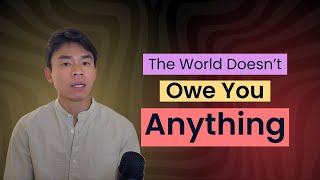
If you are 21 and feel lost, good. That feeling is exactly what drives change. Use the energy to move: build something, fail, struggle a little, course-correct and repeat until something works. The world does not wait for you to be ready. It rewards people who move.

If the skill you choose to build is coding, it is one of the most flexible ones you can pick, useful for a job, freelancing or your own product. You can try it properly, at no cost, with our free trial.

Questions people ask

  • Should I go to university if I do not know what I want to do?

    Think carefully before defaulting to it. If your career requires a degree, such as medicine or law, go. If you are unsure, four years can cost a lot of time and money while feeling productive. Many employers now care more about whether you can add value. Building real skills and testing what you enjoy first can be a better use of that time.

  • How do I stop being broke in my 20s?

    Focus on skills that create value people will pay for, such as selling, building, coding or writing, and start using them early, even on small projects. Spend less on status symbols and reinvest money and time into skills and assets that can grow. Take action quickly, accept failures as lessons, and protect your time from distractions and people who hold you back.

  • Is reading self-help books a waste of time?

    Not entirely, but reading can easily become procrastination disguised as progress. Treat books as a pre-workout: useful for ideas and motivation, worthless without action. A better approach is to read one book, then immediately apply one idea by building or launching something small, and learn from what the market tells you.

  • How do I stop procrastinating?

    Remove the opportunity. Keep your phone out of reach while you work, block the apps that eat your time, and schedule short, fixed blocks for learning a skill. Treat it as a discipline problem rather than a motivation problem: if you can find hours to scroll, you can find 30 minutes to learn. Start, and the motivation often follows.

Your next step

Our 12-week AI-Native Software Development Programme is a live, mentor-reviewed cohort where you build and ship real products with AI, and learn to explain every line. Start with the free trial to see how we teach, then decide.

Watch next

All videos

Learn the fundamentals that pay off in any direction.
Coding plus AI, taught properly.

Whatever you end up doing, the people who understand how software and AI actually work get to direct them. Try the first lessons free, no card needed, or see the full 12-week AI-Native Software Development Programme.