

What is a coding bootcamp?
Coding bootcamp is a short-term, intensive programme that teaches software development skills through hands-on projects and practical training. Unlike traditional university degrees, coding bootcamps focus on helping students build real-world skills that can be applied directly in software development and technology careers.
Modern coding programmes often cover web development, databases, APIs, AI tools, software engineering principles, and portfolio-building projects. Many are designed specifically for beginners with no prior coding experience.
If you're considering a career in tech, this guide will explain how coding bootcamps work, what you'll learn, and whether they're the right fit for you.
Learn More: Coding Bootcamp with Job Placements
Purpose of Coding Bootcamps in the Tech Industry
This kind of AI-native software development bootcamp plays a crucial role in addressing the tech talent gap. With traditional educational institutions often unable to keep pace with the rapid advancements in technology, bootcamps offer a dynamic and flexible alternative. They provide a fast-track route into tech careers, catering to individuals without a technical background.
These programs are designed to meet the immediate needs of the industry, equipping students with current and relevant skills. By focusing on the most in-demand programming languages, AI tools, and automation skills, coding bootcamps help fill the growing shortage of qualified tech professionals, particularly those who can build and work alongside AI.
Related: What Jobs Can You Get After Coding Bootcamp
Coding Bootcamps vs Traditional Education (University Degrees)
While both coding bootcamps and university degrees aim to educate and prepare individuals for careers in technology, they differ significantly in several aspects:
Time Efficiency
Coding bootcamps are typically shorter in duration, ranging from a few weeks to a few months, compared to the four-year commitment required for a traditional university degree. This allows students to enter the workforce more quickly.
Cost-Effectiveness
The cost of a coding bootcamp is generally lower than that of a university degree. Additionally, many bootcamps offer payment plans, scholarships, and income share agreements to make education more accessible.
Also read: How to Pay for a Coding Bootcamp
Practical Focus
Coding bootcamps emphasize hands-on learning and real-world projects. Students work on practical tasks that mirror the challenges they will face in the workplace, ensuring they are job-ready upon graduation.
Flexibility
Coding bootcamps offer various learning formats, including part-time, full-time, online, and in-person options, allowing students to choose a schedule that fits their lifestyle.
Learn More: Coding Bootcamp vs. Degree in Computer Science
Why Choose a Coding Bootcamp?
1. Benefits of Coding Bootcamps
Attending a coding bootcamp offers numerous advantages, making it an attractive option for aspiring tech professionals:
- Accelerated Learning: Bootcamps condense a vast amount of information into a short period, enabling students to learn quickly and efficiently.
- Industry-Relevant Skills: The curriculum is designed to align with current industry demands, including AI integration and automation, ensuring that students acquire skills that are immediately applicable in the job market.
- AI-Ready Training: Modern bootcamps like Sigmaschool's AI-Native Software Development Programme teach you to build with AI, not just alongside it, so you graduate with skills that reflect how the industry actually works today.
- Networking Opportunities: Bootcamps often facilitate connections with industry professionals, instructors, and fellow students, providing valuable networking opportunities that can lead to job placements and career advancement.
- Career Support: Some coding schools, like Sigmaschool, also offer comprehensive career services, including resume building, interview preparation, and job placement assistance, which help graduates secure employment after completing the program.
2. Coding Bootcamps Facilitate Career Changes

Coding bootcamps are particularly beneficial for individuals looking to switch careers. These coding programs are structured to provide the necessary skills and support to transition into the tech industry.
Key factors include:
- Focused Curriculum: The targeted curriculum ensures that students learn essential skills without unnecessary coursework, making the transition more efficient.
- Support Systems: Bootcamps often provide mentorship, tutoring, and peer collaboration to support students throughout their learning journey.
- Real-World Projects: By working on real-world projects, students gain practical experience and build a portfolio that showcases their abilities to potential employers.
Read further: Is a Coding Bootcamp Worth It
Learning Options Offered by Coding Bootcamps
1. Flexible Learning Options in Coding Bootcamps
Not all coding bootcamps are structured the same way. Today, students can choose from several learning formats depending on their schedule, learning style, and career goals.
Full-Time Programmes
Full-time programmes are designed for students who can dedicate most of their time to learning. They typically offer a faster path into tech but require a significant time commitment.
Pros:
- Faster completion
- Immersive learning experience
- Strong momentum and accountability
Cons:
- Difficult to balance with a full-time job
- Higher time commitment
Part-Time Programmes
Part-time programmes are designed for working professionals, students, and career changers who need to learn around existing commitments.
Pros:
- Easier to balance with work or studies
- More flexibility
- Lower risk when changing careers
Cons:
- Takes longer to complete
- Requires strong self-discipline
Online vs In-Person Learning
Many coding programmes are now delivered online, allowing students to learn from anywhere in the world. In-person programmes may offer more face-to-face interaction, while online programmes provide greater flexibility and accessibility.
A Newer Approach: Flexible, Structured Learning
In recent years, many coding schools have moved beyond the traditional full-time versus part-time model.
Instead, they combine structured learning paths, mentor support, project deadlines, and career coaching with the flexibility to learn around work and personal commitments.
At Sigmaschool, students follow a guided roadmap with mentor support, hands-on projects, and career preparation while maintaining the flexibility to learn at a pace that fits their schedule.
This approach aims to provide the accountability of a structured programme without requiring students to put the rest of their lives on hold.
2. Accessibility of Bootcamps: No Prior Coding Experience Needed
One of the key advantages of coding bootcamps is that they are accessible to beginners with no prior coding experience. These programs are designed to start from the basics and gradually build up to more advanced topics.
Here are some features that make bootcamps beginner-friendly:
- Foundational Courses: Introductory modules cover basic programming concepts and tools, ensuring that all students, regardless of their background, can keep up with the coursework.
- Support Systems: Bootcamps provide various forms of support, such as mentors, tutors, and peer collaboration, to help students overcome challenges and stay on track.
- Incremental Learning: The curriculum is often structured to introduce concepts progressively, allowing students to build a solid foundation before moving on to more complex topics.
- Hands-On Practice: Emphasis on practical exercises and projects helps students apply what they learn, reinforcing their understanding and building confidence.
These features ensure that even those with no prior coding experience can successfully navigate a coding bootcamp and emerge with valuable skills.
Also read: How Hard is Coding Bootcamp
What to Expect from a Coding Bootcamp
Coding bootcamps are designed to help students go from complete beginners to building real software projects in a relatively short period of time. While every programme is different, most modern coding programmes focus on hands-on learning, portfolio projects, and practical skills that reflect how software is built in the real world.
Here's an example of what students learn in Sigmaschool's AI-Native Software Development Programme.
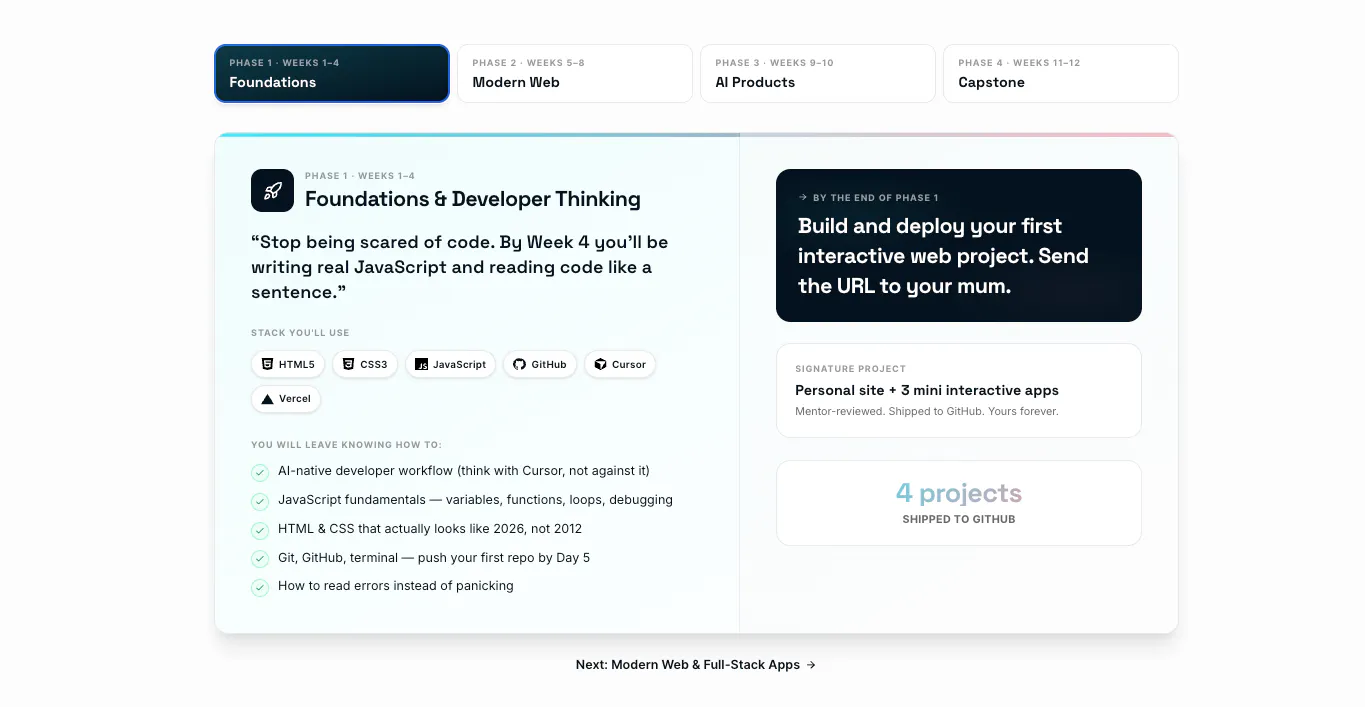
Phase 1: Foundations & Developer Thinking
Students start by learning the fundamentals of HTML, CSS, JavaScript, Git, GitHub, and AI-native development workflows using tools like Cursor.
By the end of this phase, students deploy their first interactive web projects and learn how to read, debug, and understand code with confidence.
Phase 2: Modern Web & Full-Stack Apps
Students move into React, Next.js, TypeScript, Supabase, and PostgreSQL to build full-stack applications with authentication, databases, and real users.
The signature project is a Job Application Tracker, a SaaS-style application that demonstrates practical full-stack development skills.
Phase 3: AI Products & Software Quality
Once the fundamentals are in place, students learn how to integrate AI into software products using OpenAI and Claude APIs.
They build AI-powered features, learn prompt design, improve code quality, and develop the skills needed to work effectively with AI as a developer.
Phase 4: Capstone & Career Execution
The final phase focuses on building a capstone project, optimizing portfolios, preparing for interviews, and developing a strategic job search plan.
Students graduate with multiple deployed projects, a polished portfolio, GitHub profile, and a clear path toward their first role in tech.
Related Reading: Careers in Coding: Full Stack vs Front End vs Back End Developers.
2. The Hands-On Learning Experience
Coding bootcamps emphasize a hands-on learning approach, which is crucial for mastering programming skills.
Here’s what you can expect from this immersive experience.
Real-World Projects
Students work on projects that simulate real-world scenarios, giving them practical experience and a portfolio to showcase to potential employers.
- Project-Based Learning: Applying theoretical knowledge to build functioning applications.
- Portfolio Development: Creating a portfolio of projects to demonstrate skills and experience.
Collaborative Environment
Bootcamps often foster a collaborative atmosphere, where students collaborate on projects, share knowledge, and support each other.
- Peer Collaboration: Learning to work in teams is a critical skill in the tech industry.
- Networking: Building connections with classmates and instructors.
Immediate Feedback
Instructors and mentors provide timely feedback on assignments and projects, helping students understand and correct mistakes quickly.
- Mentorship: One-on-one guidance to navigate challenges and improve skills.
- Support Systems: Access to help from tutors, teaching assistants, and peers.
This immersive and intensive nature of bootcamps ensures that students are well-prepared for the demands of a tech career by the time they graduate.
Related: How to Prepare for a Coding Bootcamp
Deciding if a Coding Bootcamp is Right for You
Coding bootcamps offer a compelling pathway into the tech industry, especially for those without prior experience. The benefits include rapid skill acquisition, industry-relevant curriculum, networking opportunities, and robust career support.
When considering a coding bootcamp, reflect on your career goals and personal circumstances to determine if this fast-paced, immersive learning experience aligns with your aspirations.
Beginner's Guide: Choosing the Right Coding Bootcamp for Beginners
Explore More: The best way to learn coding in 2026
Ready to Start Your Tech Career?
A coding bootcamp can help you go from complete beginner to building real software projects in a matter of months.
The key is choosing a programme that teaches not only coding fundamentals, but also how modern developers work with AI tools, real-world applications, and industry-standard workflows.
Sigmaschool's AI-Native Software Development Programme combines software development, AI integration, portfolio building, mentorship, career support, and a Money-Back Guarantee to help students launch careers in tech.
Whether you're starting from scratch or changing careers, your first step is simply getting started.
Explore the AI-Native Software Development Programme and begin building today.
FAQ
What is a coding bootcamp?
A coding bootcamp is an intensive training programme designed to teach software development skills in a shorter time frame than a traditional university degree. Most programmes focus on practical, job-ready skills and real-world projects.
Can I join a coding bootcamp with no coding experience?
Yes. Many coding bootcamps are designed specifically for beginners and start with fundamental programming concepts before progressing to more advanced topics.
How long does a coding bootcamp take?
The duration varies by programme. Some intensive bootcamps last a few months, while flexible programmes allow students to learn at their own pace while working or studying.
Are coding bootcamps worth it?
For many career changers and aspiring developers, coding bootcamps can be a faster and more affordable pathway into the tech industry compared to traditional degree programmes.
What jobs can you get after a coding bootcamp?
Common career paths include software developer, web developer, data analyst, QA tester, cybersecurity analyst, and AI application developer roles.