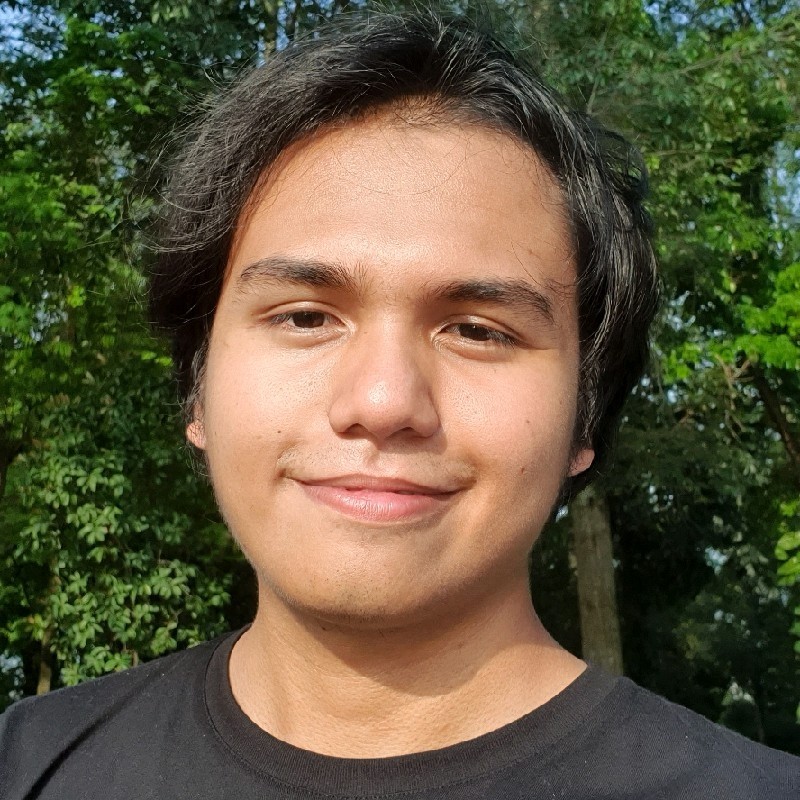
Adam Halid
Sigmaschool graduate
He learnt to code while caring for his sick father
Before
Mechanical Engineer
Now
Senior Full Stack Engineer
@ Biomed Global
Drones, then everything stopped
Adam graduated in mechanical engineering with no IT background to speak of. He had touched C++ fundamentals years earlier, but barely remembered any of it. While finishing his degree he worked at a drone company, and stayed on after graduating, because the work itself was the draw. "We were doing it out of passion, because he was doing really cool stuff," he says of his boss there.
Passion was carrying more weight than it should have. The company had stopped paying him, and the unpaid months kept stacking up while he kept working. Then his father got sick, and there was no one else to look after him. The decision made itself. "Everything aligned. I had to quit my job, and that's the only way I saw at that moment."
So he quit, and spent the next few months at home attending to his dad. Between the caregiving there was a lot of spare time, and a question about what to do with it.
The subscription he remembered
The answer was something he had bought and abandoned. A year or two earlier, Adam had signed up to Sigmaschool, dipped a toe in, and never explored it properly. Sitting at home with time on his hands, he remembered the subscription was still there. "I thought, oh, it's a good time to just go back." He used the whole period of caring for his father to pursue web development.
Asked why then, and not a year earlier or five years later, he does not dress it up. "Given my circumstances, I didn't really have much of a choice. I couldn't go to work, but I had time. What else could I do?" He had already put a foot in the water before; now the timing had finally come together.
There was a dream attached to it too. Beyond the circumstances, what pulled him towards code was the image of living as a digital nomad. "You can just go anywhere in the world and work. The world is your oyster. There's nothing actually stopping you from exploring the world." It is 2025, everything is digitalised; as long as you do your job, he reasoned, it should not matter where you are.
“Always be coding. If you always do that thing, you're going to improve and you will get there. It's just time and effort.”
The nomad dream meets the office
The funny thing is that working in tech changed his mind about the dream that got him there. Ask him now and he does not think the nomad life is sustainable, and not only that: "I still think that you need to come to the office. There's something about interaction with your co-workers that has to be in physical form that is unmatched with doing it online."
It is not that remote work fails technically. What goes missing, in his experience, is the sense of connection. Online, you see your colleagues on a screen for half an hour, you shut the laptop, and that is about it; in tech especially, people just get the work done and rarely talk. In person it is friendlier, and communication, the thing he now rates as the most important skill in the job, works better.
So the revised plan is simpler: go to the office, and when he needs the world, "just go for a holiday and take some time off. That's probably better."
JavaScript and the small-project grind
When he started, web development was the only corner of tech he could see, and JavaScript was the only language he knew. The hardest part was not syntax but the layer underneath: understanding the concept of how a language actually works. Nothing about his engineering degree had prepared him for that mental model.
His fix was volume, not theory. He built small projects constantly: a timer, a to-do list, the normal stuff you see online, over and over. "Always keep on doing it, and then you'll figure things out."
He has a comparison he keeps returning to. "Coding is like maths. If you always do it, at one point you just know how to do it." You stop being able to explain it fully; your brain makes sense of it, something clicks, and then, "oh, so this is how it works."
The self-paced era
Adam joined in an earlier era of the school, before it was even called Sigmaschool, when the programme was self-paced. There was no fixed timeline and no mentors assigned to you; live sessions ran maybe once every week or two, with slots where you could bring questions. What it did have was an enormous library of material. "The resources back then were huge. It was for you to explore and to read. I really liked it."
That firehose had a side effect he is grateful for: it showed him how much of tech exists beyond web development. But he is honest that it was a different model from the structured, tailored bootcamp that exists now, where the syllabus is cut down to what you need to get hired. Back then, he says, "they'll give you everything, so do what you want."
Specific things stuck. For CSS he played browser games like Flexbox Froggy, because as a gamer he found they helped him visualise layouts instead of staring at boxes. For JavaScript, the projects did the teaching, and one in particular: a dinosaur game that, he says, "really helped me a lot to understand pure functions."
An interview earned washing plates
His first tech job started at a friend's wedding, where Adam was helping out by washing plates. One of the friends washing plates next to him knew he was trying to break into web development, and mentioned that a friend of his was a manager at a company. Try talking to him, he said, and see if you can get an interview. So Adam did.
There was one problem: none of his projects were deployed anywhere. But he had recorded all of them on his phone, so that is what he showed the manager. Screen recordings, straight off a phone, at a wedding. The reply: "Oh yeah, this looks cool. Send me a resume. This is my email."
He tells that story as evidence for the thing he repeats most. Both of his tech jobs came through referrals. "Connections, guys, connections. Networking, man. Networking is so important."
Five days, two hours of sleep
The interview process that followed was, in his words, so hard. He had landed himself in the running for a full stack role knowing only HTML, CSS and JavaScript. "I don't know anything about back end whatsoever," he says of himself at the time. The assessment did not care: build a complete app, front end and back end, with login and authentication, in a specific stack of React, TypeScript, GraphQL, TypeORM and PostgreSQL.
He had about five days. "I didn't sleep at all. I mean, I slept like two hours a day minimum, maximum three hours, I think." He was calling friends for help as he went: how do you do this, how do you do this.
He shipped it, and he got the job. Looking back at how a frontend-only beginner survived a full stack gauntlet, his explanation is short: "I just do whatever it takes."
Backend years and 17 vulnerabilities
That first role, at a Malaysian software house, turned out to be almost entirely backend. Maybe five per cent of his work touched the UI; the rest was server-side, mapping to databases, nothing visual. It was the opposite of what he expected, and it quietly built the other half of his skill set.
The project he is proudest of started as a corridor conversation, because Adam talks to everyone, not just his own team. Chatting with one of the two people on the cloud team, he heard the company had a document in from a third party being hired to run a penetration test, checking how many vulnerabilities their app had. Adam said it sounded interesting. That was all. "He told his manager, and his manager told my boss, and then my boss said, oh, so now you want to do it? I'm like, I didn't say I want to do it!" The job was his.
The pentest surfaced around 17 vulnerabilities, and he worked through and eliminated all of them except some small edge cases that did not matter. More than the fix count, the project rewired his map of the field: application security was a whole discipline he had never seen from his desk. "It opened my eyes to what's out there."
After almost two years he decided to leave. Not because he had stopped progressing, he is clear there were still many things he could improve there, but because he needed a different environment and a change of pace.
Frontend at The Access Group
The second job came the same way as the first: through a referral. He joined The Access Group as a frontend developer, a UK-based company with a long list of products, working on one of them. After two years of mostly backend, front end is the muscle he wants to build. "I suck at front end," he says cheerfully of his starting point. "I don't know how I managed to get the job, actually."
The real struggle in the new role is not the code. "The magnitude is bigger than what you think. It's not just web development, it's not just front end. It's corporate." He has to liaise with clients and chase them, wait on other teams for tickets, and live with the fact that a client's delay lands on him, affecting bonuses, incentives, the entire company.
His summary of the lesson is the one he opened with: "Communication is always the most important thing." The technical translation is the easy half, because front end is visual and everyone can see what is going on; explaining a UI to a layman is not hard. The hard half is the coordination between multiple teams, colleagues and clients, and he admits he is still figuring that part out.
He has kept climbing since. Today Adam is a Senior Full Stack Engineer at Biomed Global, working across the whole stack he once split into backend first and front end second.
Imposter syndrome, every day
Ask Adam if he ever felt imposter syndrome and the answer comes back instantly: "That's every day. Even now." He thinks the feeling is close to universal in software, and he refuses to treat it as a defect. "You won't feel that you're good enough in doing things that you want yourself to be good at. And that's okay."
His explanation of the mechanism is the most useful thing he says about it. "You're just measuring yourself with the things that you want to be, but you're not seeing what you have become from where you were." Look back at where you started, he says, and the difference is a whole other level; but you never look back, because you are not really proud of it, only chasing what is ahead. He felt exactly the same constant chase in mechanical engineering and drone work. It is anyone, in any field, who keeps trying to improve.
The insight he wishes he had on day one is blunter, and knowing it put him at so much ease: it is always going to suck. "You do one amazing thing that you think is amazing, and then a few projects later you go back and look at your code and think, who wrote this? It's always going to be like that. It's going to repeat again and again and again. And that's fine." That, he says, is true of cooking and cleaning too; you improve bit by bit, and if you ever document your life and look back, you will be shocked how far you came.
Staying sharp and what comes next
To keep up with a field that moves too fast, he curates his inputs. On YouTube he follows frontend educators like Kevin Powell, plus the Primeagen for wider software engineering news explained in layman's terms, and Fireship for the latest tech in bite-size videos. He even replaced his browser's new-tab page with daily.dev, so every time he opens Chrome he sees fresh articles instead of a blank page.
He is deliberate about tools versus fundamentals. His habit when stuck is to Google first and go through ten articles if needed, refining the search as he goes, before reaching for AI. In his view a chatbot answer might patch the problem short term, but when the code breaks later, someone still has to actually understand it.
As for where he is heading: freelancing is the aspiration, and front end suits it, since most freelance work revolves around the front end. But he has also realised an aspiration does not have to become the job; it can live on the side. Further out he wants to explore cloud and cybersecurity, on top of the data science certificate he earned over six months and promptly shelved when web development hired him first. The destination is to be a generalist, "good at everything, not the best, but something." He has a wage goal too, in the ballpark of 20K within about six years, and he does not apologise for it: money is not everything, but it is something.
What excites him about tech is precisely that he cannot predict it. "You never know what's going to happen. When it comes to tech, you can build things in your own backyard, in your own room. Just a laptop and Wi-Fi, that's all. Maybe you don't even need a table, just a beanbag, and you build stuff, and when it comes out it's the most amazing thing ever."
Always be coding
His advice for aspiring developers starts one level higher than most. "Software development is not just web development." There are systems roles, sysadmin, DevOps, data science, data analytics, data engineering, cloud, AI engineering, and each path has its own languages. Do your research first on which role you actually want, he says, and from there you will uncover the next thing one by one.
Once you know what you want, he hands over the rule he got from Harris, his old instructor, and holds onto still: follow the ABCs. Always be coding. "If you always do that thing, you're going to improve and you will get there. It's just time and effort. 10,000 hours, however many hours you need, you'll get there." Everyone gets the same 24 hours; the difference is what you spend them on.
The same patience applies to his life outside work. This year's resolutions include learning to swim (he sinks the moment he has to float, and suspects it is nerves), learning guitar, and hiking to Annapurna Base Camp in Nepal, maybe in September. The lifetime goal is the best one: he wants to build a house from scratch, the way the long-form YouTube builders do it, digging the base out of the ground and pulling the cables in from the source. He has not started any of it yet. But as he says himself, the first step to doing anything is just start.
Could this be you?
Adamstarted with no coding background. Try the same programme free, or see exactly what you’d learn.
More stories
View all
Dickson Goh
Business Analyst @ Stampede Solution
He did the bootcamp, tried a dev internship, then found the role that fit
Read story
Nixon Siow
Software Engineer @ Property213
He thought about it for a year, then quit his four-year job to learn to code
Read story
Adrian Lin
SEA Career Development Specialist @ Boston Consulting Group (BCG)
Tax, headhunting, then a career break that turned into code
Read storyYour turn
Their before looked a lot like your now.
Every one of these people started with zero. The difference is they started. See the programme they took, or talk to us about whether it fits you.