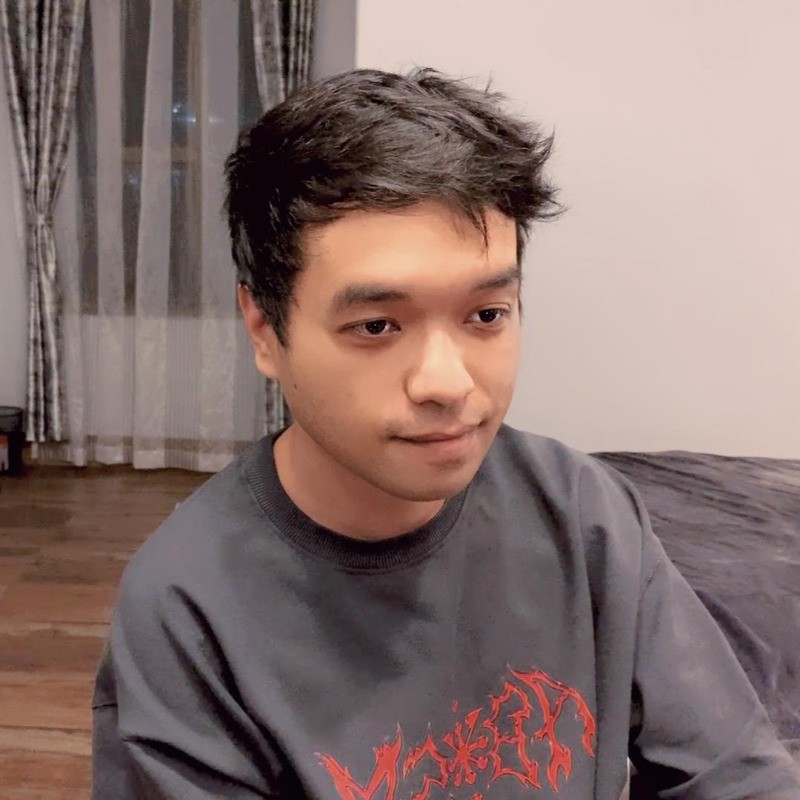
Wanroy Challam
Sigmaschool graduate
From a KL music studio to building software at Sigmaschool
Before
Music Producer
Now
Software Developer
@ Sigmaschool
Paycheck to paycheck in a KL studio
Wanroy Challam had built his whole life around music. He moved to Malaysia in 2018 for a masters in music production and stayed until 2022, and after finishing the degree he went to work at a recording studio in Kuala Lumpur, 2AM Studios.
The work was real. The money was not. "It doesn't pay much. I was living paycheck to paycheck," he says. Studio life had given him the craft he had trained for, but not a living he could build anything on.
Towards the end of the pandemic, a friend mentioned coding bootcamps, something Wanroy had never heard of at the time. The idea landed on prepared ground: programming had always interested him, and he used to mod video games for fun, so the shape of the work was already familiar. He decided to give programming a try.
One email with the prices in it
He started googling bootcamps and ran straight into the obvious wall. A lot of them, he found, were crazy expensive back then. For someone whose salary disappeared every month, most of the options were simply out of reach.
Then he stumbled on Sigmaschool through a Google search. He contacted the team and got back an email laying out the programmes and the pricing, and for once the numbers worked. The pricing was reasonable enough that his answer was simply yes, he would give it a try.
That was the whole decision process: no open day, no long deliberation, just a clear breakdown of what it cost and what it covered, arriving at a moment when he was ready to move. He committed.
“If you're hesitant about it, I don't think it's going to work. You have to be 100% sure that you want to make that change.”
Leaving the guitar behind
From the outside, music to code looks like a violent turn. For him the jump was less jarring than it looks, because modding games had already made the work feel familiar. But that does not mean it was free.
He had come far in music: a masters, studio work, serious skill on the guitar. "I feel like I left a big chunk of my life and then just changed to something else," he says. At the time of the interview, he had not produced a track or played guitar in a year.
That silence is worth sitting with, because of who it comes from. He plays punk, rock, a little hip-hop, and he can play Polyphia, the band guitarists study to feel bad about themselves; his favourites of theirs to play are G.O.A.T. and Goose. A player at that level putting the instrument down for a year is the honest price tag on a career switch.
He has been thinking about picking it back up on weekends, when he is free. The music is on the back burner, not gone.
Easier than school
He did the bootcamp fully online from his home country, having already left Malaysia by the time he enrolled. He expected it to be hectic. It was not, or at least not in the way school had been. The first stretch, he says, was actually a bit chill, and then the course got to work.
What the bootcamp does, in his description, is teach you how to code right away: all the structures, something to stand on so you can get into the industry quickly. That was challenging at first, but it stayed fun. "It never felt like I was in a lot of pressure, like compared to when I was in school."
He credits two things for that. Students could go about the material at their own pacing, and his instructor Harris carried the teaching. Harris did most of the lessons, he says, and taught well enough that the concepts came easy to understand.
From day one it felt like something he could actually do. Asked whether there was ever a moment he thought enrolling had been a bad idea, his answer is a flat no.
The playlist cloner
The hardest stretch of the bootcamp was the capstone project. He built a web app on the Spotify API that clones playlists: you paste a link, press a button, and it copies the playlist directly into your own Spotify profile.
The battle was not really the code. Most of it, he says, came down to reading documentation and understanding what was actually written there. He remembers definitely struggling on it, properly, for the first time in the course. He had been apprehensive about the back end too, though that turned out to be more chill than the front-end work.
Then it clicked. "After I figured it out, it was really satisfying." That was the moment he started to believe this could genuinely be a career and not just an experiment.
Music kept leaking into his code afterwards. The last music-related project he worked on, a commission from last year, was a tool called Lucida that takes a Spotify or Apple Music link and downloads the song for you. He is not sure about the legality of that, he admits, laughing. Mostly, though, he says coding and music stayed two separate worlds in his head.
A batch that became friends
Ask him for his favourite part of the whole experience and the answer is not a technology. It is the group projects. "It feels like I'm actually working on a big project with a bunch of people."
His batch became genuine friends. They kept a group chat where everyone helped everyone else through the same struggles, and he describes the students around him as the most helpful part of the community. He will not speak for other batches, but his own, he says, was a pretty good experience.
His verdict on the curriculum is practical rather than romantic. It teaches you really fast, he says, precisely so you can get your foot into the field, and in his view it does a pretty good job of exactly that. Fast, employable, foot in the door: that was what he had paid for.
Interning before he graduated
The door opened before the course even ended. In the final month of the bootcamp, around August 2023, Wanroy started interning on Kodio, one of Sigmaschool's products, working with its small developer team. He stayed on the internship until December of that year.
By then he knew exactly what he wanted: a job in this industry, nothing vaguer than that. So he started looking for one, and he found one with a company based in his hometown.
For most bootcamp graduates, the stretch right after the course is the hardest chapter of the story: the applications, the doubts, and then the elation when an offer finally lands. Asked whether he faced any of that resistance at all, his answer is honest: not really. The stressful, uncertain waiting would still come for him, but later, and in a different form.
He is aware of how that sounds against the market, and he puts it down to luck rather than brilliance, because he knows a lot of people from his batch were struggling to find a job at the time. Out of the whole batch, he was one of only two who landed a role right away after graduating.
A year of hotel websites
His first developer job was at a small company that builds websites for hotels and restaurants. He mainly handled the front end, and he stayed for a year. Some of what the job needed had not been in the bootcamp, so there was a learning curve, but the foundation held. What he had learnt at Sigmaschool helped a lot, he says, and the rest turned out to be nothing too crazy.
A programmer friend had told him something that kept him going there: once you get into the industry, finding the next job at a different company gets easier, because now you have experience. He treated the role exactly that way, as the thing that got his foot into the industry, whatever else it was.
The problem was not the work, which he found fun. The company was tiny and had no fixed working hours, so they would simply call at random times of the day with tasks. "I like going out. I can't stay home all day waiting for them to call." He decided their schedule was never going to work with his life, and he left, with no backup job lined up.
Two stressful months
After leaving, he texted Deric, Sigmaschool's founder. The answer at the time was that there was no opening. So he freelanced, picking up commissions every now and then, and the pay was exactly as reliable as commissions are: inconsistent by nature, arriving project by project or not at all.
He needed something he could depend on every month, and the wait wore on him; he does not dress those months up as anything other than stressful. The stress had a sharper edge because of what he could see in the market: these days the field is very hard to get into, he says, let alone without a traditional degree behind you.
About two months later, Deric messaged him back. There was an opening now, did he want to try for it? "I felt relieved. Right away I was like, yeah, I'm interested."
He started on probation for around two months, and towards the end of it was told the team would love to have him full-time. By the time of this interview he had been working at Sigmaschool for about nine months.
Student to employee
His work now sits inside the products he once learnt on. He spends most of his time on Sigmaschool's LMS, translating course material into the format the platform uses, because that is the team's current priority. Beyond that he mainly works front end on Sigmaschool's other products, and sometimes helps out on the back end too.
The strangeness of the loop has not worn off. "I don't know if it's imposter syndrome or what, but it still feels surreal. Sometimes I feel like I'm still processing it, like, wait, how did I get here?"
The culture, he says, is chill in a specific, deliberate way. A manager who used to run his team had a line that stuck: it's not about the hours you put in, it's about the work you get done. That fits his schedule perfectly. As long as his task gets done, it does not matter whether it took him six hours or ten, and because he always makes sure it gets done, the job rarely feels stressful. Everyone goes at their own pace, and the deadline still has to be met at the end of it.
A skill that never sits still
The biggest mindset shift from music was not the syntax; it was how effort turns into results. Music, in his experience, runs heavily on connections. You have to know a lot of people to get projects, even working out of a studio, and your odds of success are only loosely tied to the hours you put in. Coding pays the hours back far more directly.
But it never lets you rest on what you know. "It's not like playing a guitar. Once you learn something, you know it, it's there. But in coding, everything is different all the time. It's always changing." His answer to that is unglamorous: keep up with the changes, continuously, so he stays level with everyone else. He calls that a pretty big challenge, and it is simply the job.
Ask about five years from now and he does not name a title or a company. He wants to be in a good place in his life, where he does not have to worry about having to find another job; a stable phase, in his words. After a music industry income and two months of commission work, stability is the dream for the time being, and he says so without embarrassment.
Be 100% sure
His advice for anyone eyeing the same jump starts with the risk, not the reward. It is definitely a big risk, he says plainly, especially for someone coming from a very different background. He is not interested in pretending otherwise; he left a masters and years of studio work on the table to do this.
What decides it, in his view, is not aptitude but certainty. "If you join Sigmaschool, you need to have that mindset where I need to get a job in this industry. If you're hesitant about it, I don't think it's going to work. You have to be 100% sure that you want to make that change."
He was sure. Sure enough to trade the guitar for documentation, a studio for a group chat of coursemates, and inconsistent commissions for a job building the same platform that trained him. The processing, by his own admission, is still catching up with the life.
Could this be you?
Wanroystarted with no coding background. Try the same programme free, or see exactly what you’d learn.
More stories
View all
Dickson Goh
Business Analyst @ Stampede Solution
He did the bootcamp, tried a dev internship, then found the role that fit
Read story
Nixon Siow
Software Engineer @ Property213
He thought about it for a year, then quit his four-year job to learn to code
Read story
Adrian Lin
SEA Career Development Specialist @ Boston Consulting Group (BCG)
Tax, headhunting, then a career break that turned into code
Read storyYour turn
Their before looked a lot like your now.
Every one of these people started with zero. The difference is they started. See the programme they took, or talk to us about whether it fits you.