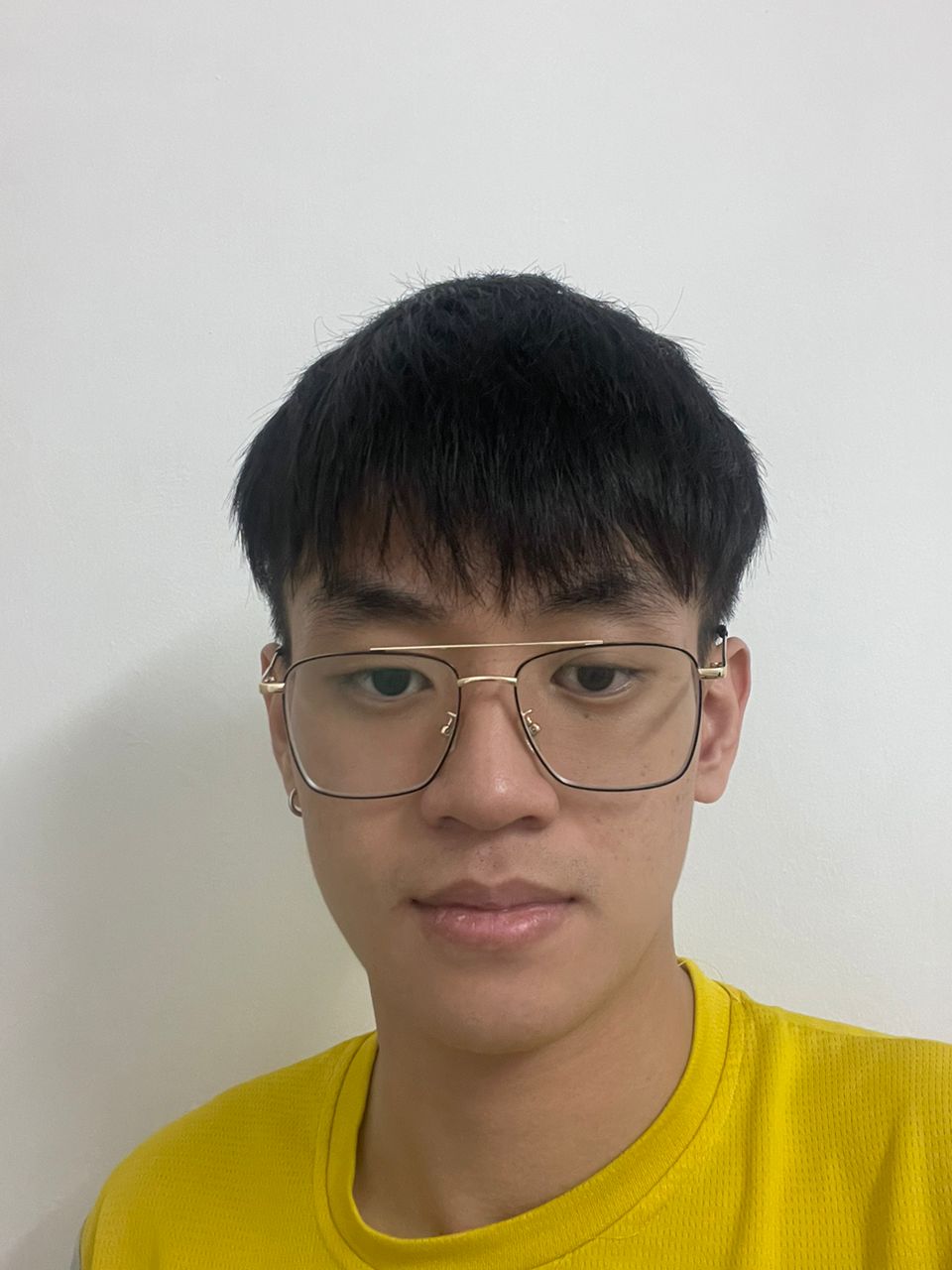
Yap Jia Hao
Sigmaschool graduate
Rejected from computer science for his maths grade, he found another way in
Before
Student
Now
Software Developer
@ IPS Software Sdn Bhd
The maths grade that closed a door
Jia Hao was interested in software long before he ever studied it. "I'm actually interested in the software thing quite a long time," he says. But a single belief kept him out of the field for years.
"I always had this mindset that in order to enrol into a computer science course, you need to have a credit in your mathematics for SPM. Unfortunately, I don't have that. My mathematics was quite bad at that time." As far as he could tell, the door to CS was closed before he'd even knocked on it.
So he didn't knock. He enrolled in a diploma in logistics and supply chain management instead, and simply completed it, the way you finish something you never quite chose.
By the time he held the diploma, he had learned something the course never intended to teach him. "I found out that I'm no longer interested in working in the logistics career field," he says. The qualification was real; the appetite for the career wasn't.
That left him fresh out of school and adrift. "During that time I was thinking, hey, what should I do in life? What's my next career path?" The old interest in software was still there, unresolved. "After that I found out that I still want to get onto the IT thing," he says. The question was no longer whether he wanted it, but how someone with a logistics diploma and weak SPM maths could get in.
First result on Google
The search that changed things was almost comically plain. One day he typed something like "short-term IT course" into Google. "The first thing that pops up on the Google search is Sigmaschool. I just clicked in, went through the whole page, and said, hey, this one is actually quite nice."
The consultation call did more than sell him a course; it dismantled the belief that had rerouted his whole education. "When I first consulted with the guy, he said, actually, you don't really need that much of the mathematics thing. As long as you have that problem-solving skill, you'll be fine."
The thing he'd treated as a locked gate for years turned out to be, at most, a low fence. Ideally he would have studied CS at university, and the maths requirement had stopped him. Now there was a route that didn't run through it.
“You never try, never know. The thing I'm more worried about is that if I never try, I will be regretting it later. So just go for it.”
A two-day decision
Joining still meant a real commitment: three months of full effort and a fee to pay. He didn't agonise. "I just thought about it one to two days, and then I was like, okay, this is the chance. I just go for it, put in 100% effort, and see whether it's worth fighting for."
His parents didn't need convincing either, even with money involved. "They were supportive. They just said, if you are doing something that you really like, then just go for it." They backed the fee too.
The logic behind the speed shows up again and again in how he talks. Deliberating longer wouldn't have changed the two facts that mattered: he wanted this, and the only way to find out if he could do it was to try.
No spoon-feeding
The course itself matched what he'd signed up for: online classes, with guidance available whenever he needed it. But he understood from the start where the real work sat. "You can't expect your teacher to spoon-feed you. You still need to find your own way to do the things. I think that's how I really learned, by doing it."
He walked in with that mentality already loaded, ready to absorb rather than waiting to be fed. It turned out to be the exact disposition his future job would demand of him, months before he knew that.
As for difficulty, no single module broke him. "For all the modules, I think it's pretty challenging, but I was still able to handle it." Challenging but handleable became the recurring shape of the whole journey.
A batch that kept each other going
What surprised him most wasn't the material but the effect the other students had on his confidence. Everyone in the batch was new, and everyone was rooting for each other. "Between the students, we were all giving support to each other. Everyone was being so positive."
That atmosphere did something specific for him, given his history of doubting himself. "It really made me feel like, if others can do it, I can really do this." The camaraderie wasn't a nice extra; it was load-bearing.
During the course, he says, he was actually quite confident, which is not how he would have described himself before it. The kid who'd ruled himself out over a maths grade was gone.
The badminton court with no website
For his capstone project, Jia Hao built a website for booking badminton sessions. It wasn't a random pick; he plays, and the project came straight out of a standing annoyance in his own life.
"The badminton court near my house area, every time I want to book a court, I can only phone call them, or I just walk into the counter and ask. There's no online website, anything, to book." Checking availability for next week meant physically showing up to ask whether next week had a free slot.
"I can't really have a website to see the timetable, to see whether it's available at that time. That's why I did that capstone project." So he built the thing he wished existed: a site where you could see the schedule and book a session without calling anyone.
Two weeks on fundamentals, then the rejections
His batch ran from August to November, and he is blunt about what came next. "I think the hardest part is after the Sigmaschool bootcamp." There was no curriculum anymore; the job hunt was his to run.
He didn't rush straight into applications. He spent another two weeks going back over the fundamentals to make sure they were solid, because he knew what was coming. "During interviews, most of the time they will be giving me some assessment test, or maybe some take-home assessment test," he says, and he wanted the basics to hold up under that kind of examination.
December he describes as a slower month: still relaxing a little after the intensity of the batch, but still learning, keeping the skills warm. The serious job hunting ran from January to March, month after month of applications with nothing landing.
The process was not kind. "I did face a lot of rejection from other companies. Some of the take-home assessment tests, I failed." Other companies skipped the tests and just interviewed him, asking technical questions, and those went okay. He kept applying anyway.
One month to prove himself
In March, an offer finally came from IPS Software, a software house building web-based systems and mobile apps. Except it wasn't a job offer. It was a one-month internship, and the tech lead didn't dress up the reason.
"He told me, I'm not really sure what your skill is, so I'm only going to offer you a one-month internship to see whether you can do it or not. You really have to put in your 100% and show me what you are capable of. If you are really able to handle it, I will convert you to a full-time employee."
A month to prove he belonged, or back to square one. "During that month, I really just tried to learn, tried to commit everything," he says. The audition was on.
Solved on the first day
The stack was on his side. IPS built with React and JavaScript, exactly what he had learned at Sigmaschool, and the early tasks were simple front-end work: adjusting layouts, and debugging issues that customers had reported.
Then came the moment that told him the training had been real. "On my first day, they gave me a task, something like a state management issue. Straight away I knew what the issue was, and I just tried to debug it and solved it on my first day."
"That moment I realised, hey, I actually learned this before, and I can straight away apply it. That's what really amazed me." Day one of a one-month trial, and he had already turned classroom knowledge into shipped work.
Small team, nowhere to hide
IPS runs on a team of eight or nine people, some of them interns, with only a few experienced full-timers. In a team that small there is no cruising and no hiding; the work you do, or don't do, is visible to everyone. The seniors were busy with their own tasks, so help came in the form of pointers: look at this part, see whether it's that.
"Compared to other colleagues, they are more experienced than me, and I still struggled on some of the tasks given to me," he admits. "But I just approached them and tried to get some tips, and then based on the tips they gave me, I tried to find out the problems and fix them." Half guidance, half self-rescue, exactly the pattern he'd practised in the course.
When the month ended, the conversion to full-time came through, and it caught him off guard. "I didn't really expect that. I was relieved, because I finally proved I'm able to work as a full-time employee." That moment, he says, he was really happy.
Even then it wasn't over: full-time status came with another three-month probation. He passed that too. Two trials, two clearances, in a company where every contribution was in plain sight.
When the interviewer pointed out that a small team leaves you nowhere to coast, with the boss and management right there, Jia Hao didn't argue. That pressure was part of the deal, and in his telling it worked in his favour: it pushed him to a level he might not have reached in a bigger company where a junior could disappear into the crowd.
The day everything made sense
For a long stretch, learning felt like collecting pieces without seeing the picture. "Before this, I didn't really know how all the things work. I felt lost, but I just kept trying, kept trying." Then the picture arrived all at once. "Suddenly one day, everything just makes sense all together." At work now, he can look at an issue in one part of the system and straight away know how to solve it.
The doubt, though, never fully left. "Even until this day, I sometimes still doubt myself, whether am I able to do it," he says, especially since the full-time job scope is harder than the intern one was. What answers the doubt is his own track record. "Luckily, every time I did pull it off. When I look back at the start, I think, I'm actually able to pull it off every time."
That's why, when asked about the biggest mindset shift the pivot required, he puts confidence first. "Before this, I always doubted myself, whether can I do this. If you have the correct mindset, then anything, actually, you can do it. It's just how long it takes." The second ingredient, he says, is problem-solving skill, the same thing the consultation call told him mattered more than maths.
Never try, never know
Jia Hao is 23 now, and his goals for the next few years are concrete. He wants to become a more experienced developer and, in a few years, a senior one, and eventually lead a small team. With AI moving as fast as it is, he says, he has to keep up with it every day, so he's building his technical skills and his leadership skills at the same time.
His advice for anyone weighing the same pivot is the reasoning he used on himself. "If you are really interested in tech, I would say just go for it, because you never try, never know. The thing I'm more worried about is that if I never try, I will be regretting it later."
And the biggest lesson from the past few years comes out just as plainly. "Never give up. Whether you are old or young, the things you wanted, just go for it, work hard, and try to get it." It is exactly what he did: a closed door, a Google search, a two-day decision, and a one-month trial he turned into a career.
Could this be you?
Jia Haostarted with no coding background. Try the same programme free, or see exactly what you’d learn.
More stories
View all
Dickson Goh
Business Analyst @ Stampede Solution
He did the bootcamp, tried a dev internship, then found the role that fit
Read story
Nixon Siow
Software Engineer @ Property213
He thought about it for a year, then quit his four-year job to learn to code
Read story
Adrian Lin
SEA Career Development Specialist @ Boston Consulting Group (BCG)
Tax, headhunting, then a career break that turned into code
Read storyYour turn
Their before looked a lot like your now.
Every one of these people started with zero. The difference is they started. See the programme they took, or talk to us about whether it fits you.