The question every beginner asks before starting. A straight answer about what AI actually replaces, what it does not, and which skills still get people hired.
3 lessonsAbout 9 minFree, no account needed
What you learn
What AI automates in software work
Which developer skills hold value
How to position yourself
Lesson 1 of 3 · 3 min
If AI writes the code, why learn to code?
You are about to spend months learning to write code by hand, at the exact
moment a machine can produce it in seconds. It would be strange not to
ask whether that is a waste of your time.
So here is the honest answer, and it is not "don't worry about it".
Writing code stopped being the bottleneck
When something becomes nearly free, it stops being the constraint. Code
generation is nearly free now. What did not get cheaper is deciding whether
the code is right.
When production becomes free, the bottleneck moves to verification.
You cannot verify what you cannot read.
Think about what a working developer now does in a day: read a diff they did
not write, spot the thing that will break at 3am, notice the missing error
case, decide the data model is wrong before it costs six weeks. Every one of
those is a reading job, not a typing job.
Got cheap
Did not get cheap
Producing a first draft of code
Knowing whether the draft is correct
Boilerplate, syntax, lookups
Choosing what to build, and why
Rewriting something three ways
Debugging it at 3am when it breaks
Explaining a concept to you
Being accountable for the result
So why write it by hand here?
Because hand-coding is no longer the deliverable. It is the training input
that produces a reader.
Nobody is going to pay you to type for (let i = 0; ...). They will pay you
because you can look at 200 lines a model produced and say "this is fine,
except that will blow up on an empty array". You do not get that eye from
watching. You get it from having written the thing wrong yourself a few
times.
That is the whole design of this course: you build by hand first, so that
when you do lean on AI, you are its editor rather than its passenger.
This lesson has 1 quiz in the portal, where you tick off each step and get feedback on the code you write. Do this lesson free.
Lesson 2 of 3 · 3 min
The study: what leaning on AI does to a learner
This is not a vibe. It has been measured.
The Anthropic randomised trial (January 2026)
Developers were asked to learn an unfamiliar Python library. One group
used AI, one did not. The result:
-17%
Comprehension quiz score for the AI-assisted group. Roughly
two letter grades.
~0
Meaningful efficiency gain on average. They finished only
marginally faster.
3
Things measurably impaired: conceptual understanding, code
reading, debugging.
Read that middle number again. They paid two letter grades of understanding
and did not even get the speed.
But the study says something more interesting
The AI group was not one group. It split:
Participants who fully delegated the coding got some productivity
improvement, and lost the learning.
Participants who asked conceptual questions and used AI to check their
understanding scored well.
The difference was whether you were thinking alongside the tool, or
letting it think for you.
That distinction is the single most useful thing in this chapter, and it is
entirely under your control. Same tool, same session, opposite outcome,
decided by what you type into it.
What this looks like in practice
Letting it think for you
Thinking alongside it
"Write me a BMI calculator"
"Why is my result NaN when the input is empty?"
Paste error, paste fix, move on
"What is this error actually telling me?"
Accept the code because it runs
"Walk me through line 12, I don't follow it"
This is exactly why Sigmo AI never hands you an answer. It asks you one
question at a time until it clicks. That is not us being difficult, it is the
column on the right.
This lesson has 1 quiz in the portal, where you tick off each step and get feedback on the code you write. Do this lesson free.
Lesson 3 of 3 · 3 min
So will there still be jobs? What the data says
The previous lesson was about you. This one is about the market.
Who is saying this
Andreessen Horowitz (a16z) is one of the largest venture
capital firms in the world, managing tens of billions of dollars. They were
early investors in Facebook, Airbnb, Stripe, Coinbase, GitHub, Slack,
Instagram and Lyft, and they are among the heaviest investors in AI
companies today.
That last part matters both ways. They have every reason to be optimistic
about AI, so read them with that in mind. They also have billions of dollars
riding on reading the labour market correctly, which is a strong reason to
get it right.
The doom case quietly assumes there is a fixed amount of work to be done,
so any work a machine takes is work a human loses. Human wants are not fixed.
Keynes predicted automation would give us a 15-hour week; instead we invented
more things to want, and more work to do.
2. Every previous time, the same shape
Technology
What it destroyed
What happened next
Farm machinery
US farm work fell from ~33% of jobs (1900) to ~2% (2017)
Output nearly tripled; those people staffed factories, offices, hospitals, software
Electrification
5% of factories electrified in 1900, 80% by 1930
Productivity doubled for decades, and it created cars and appliances as whole industries
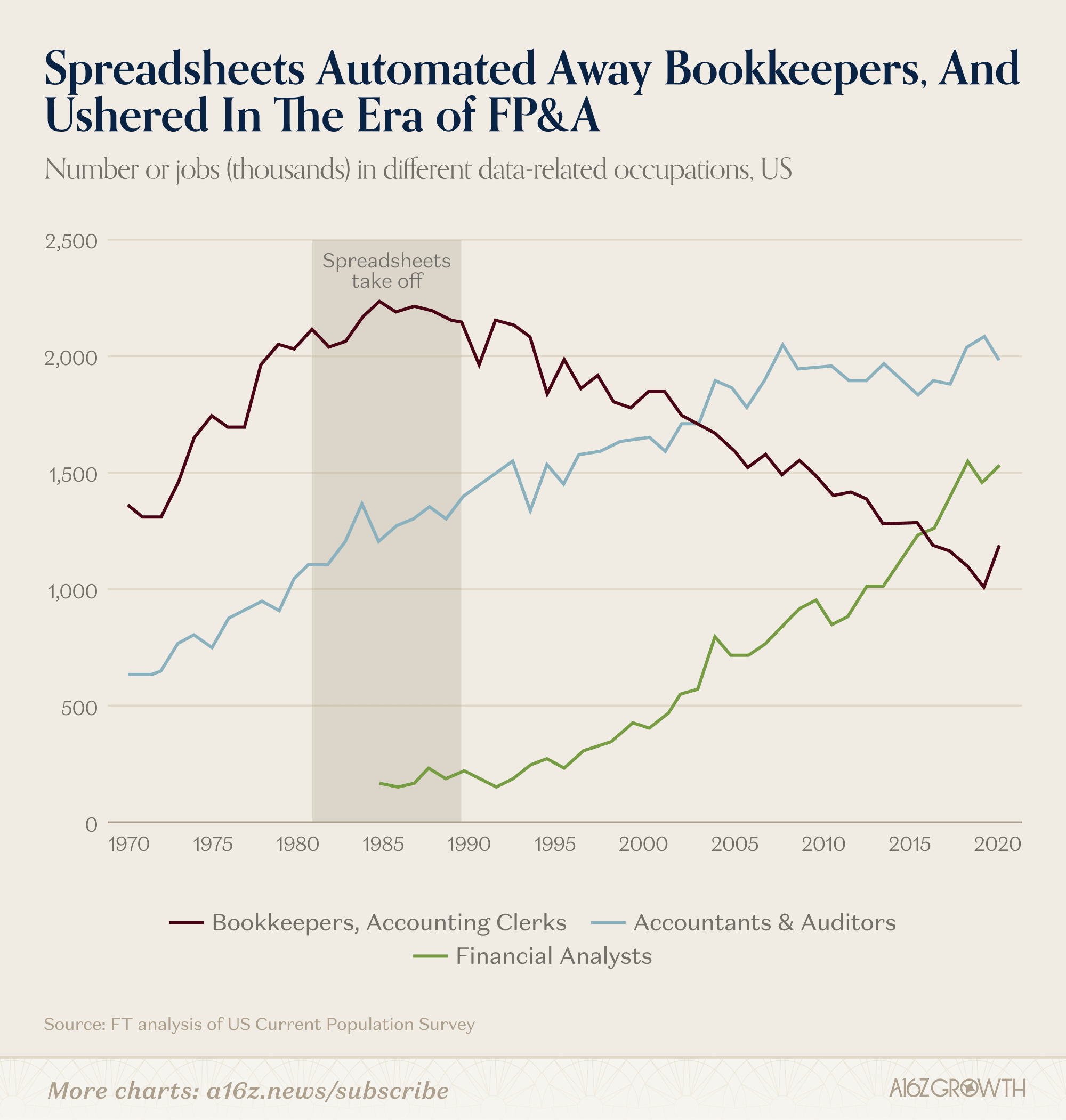
Spreadsheets
~1 million bookkeeping jobs
~1.5 million financial analyst jobs. The role moved up, it did not vanish
Online booking
Travel agent jobs roughly halved, 2000 to 2025
The ones who stayed got paid more: 87% → 99% of the average wage
The spreadsheet row is the one to hold on to. A bookkeeper did arithmetic.
A financial analyst decides what the numbers mean. Excel did not delete the
person, it deleted the typing and promoted the judgement. That is the same
trade being offered to you right now.
NBER (working paper 34984): AI adoption "has not yet led to meaningful
changes in total employment". Routine clerical work is exposed to
substitution; analytical and managerial work is complemented.
Atlanta Fed: more than 90% of firms report no employment impact from
AI over the last three years.
US Census Bureau: only about 5% of AI-using firms report any
headcount impact at all, and it splits both ways, roughly 2-4% reporting
increases and 2-2.4% reporting decreases.
Yale Budget Lab (April 2026): the picture "largely reflects stability,
not major disruption".
Overall: no statistically significant relationship between AI adoption
and unemployment.
4. And specifically for software developers
This is the part that should matter most to you. In a16z's data, software
engineering is the flagship example of augmentation, not substitution:
Git pushes are climbing steeply.
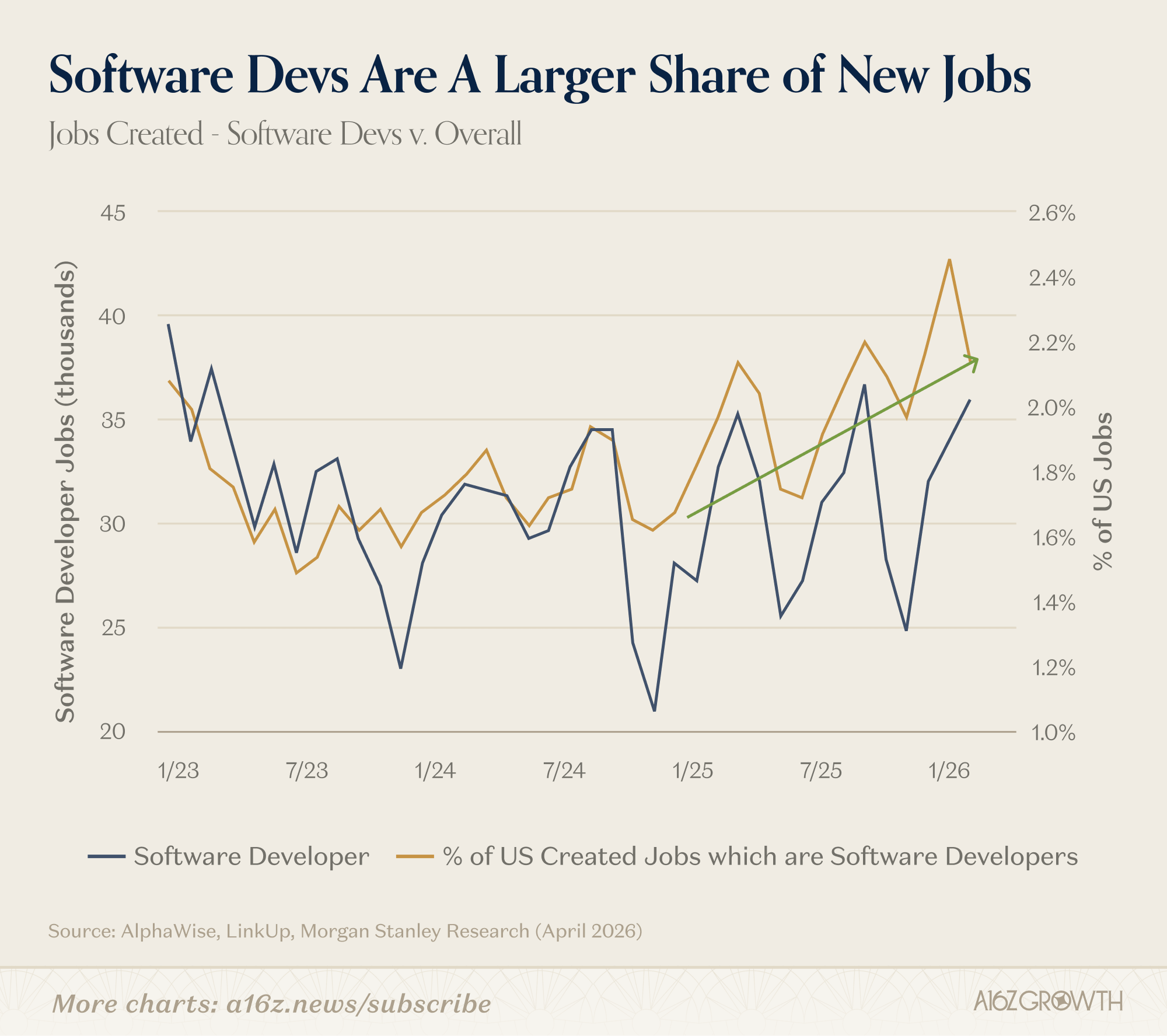
Software developer job creation has been accelerating since early 2025.
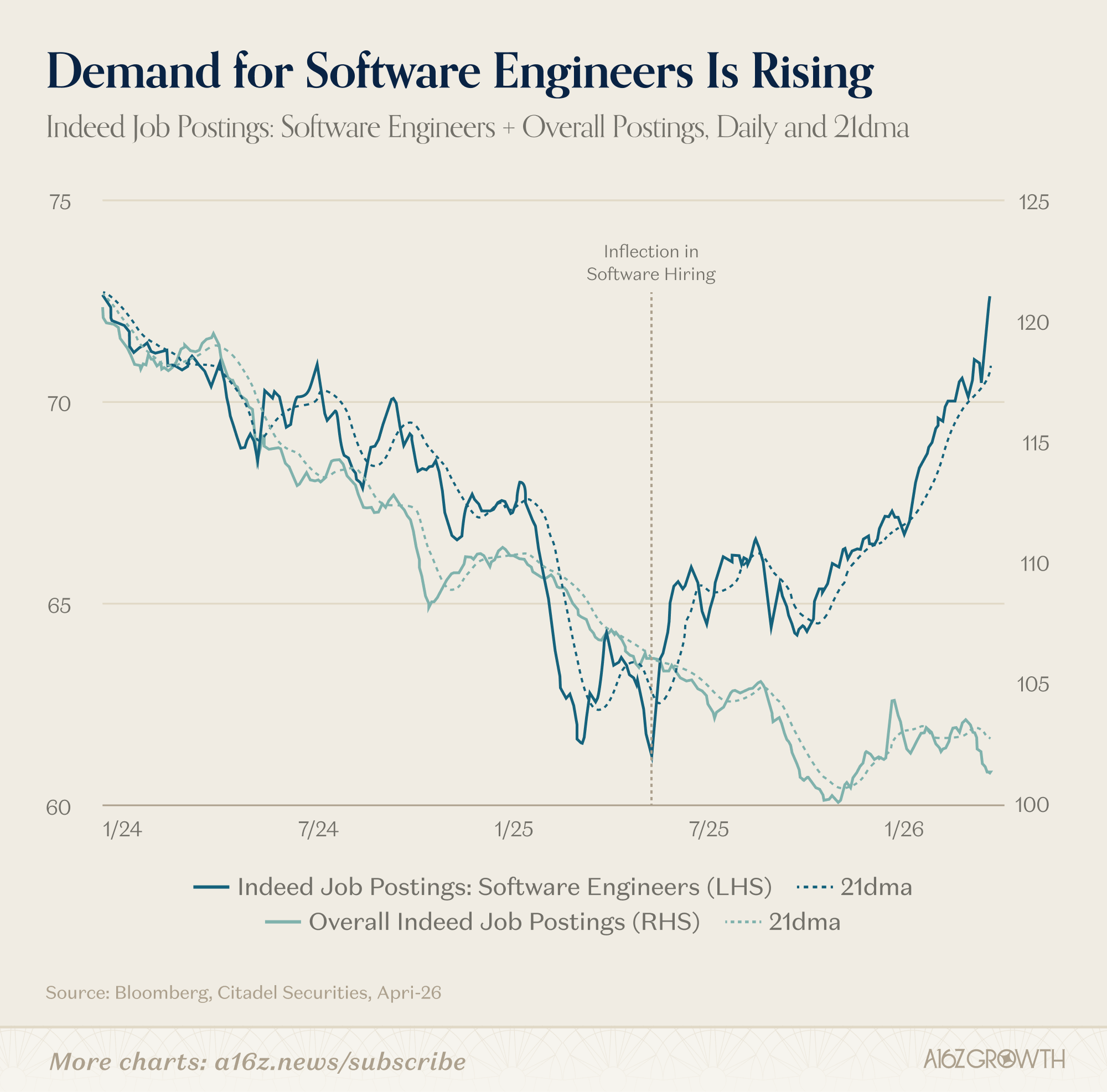
SWE job postings are rising rapidly.
Wages in computer systems design are growing above trend.
Product manager openings are at their highest since 2022, at the same time.
That last one is the quiet proof. If AI were simply eating roles, you would
not see the people who specify software and the people who build it both
in demand at once. Both rising means the same team is now shipping more, and
wants more hands.
On earnings calls, executives talk about AI augmenting their workforce
about 8 times more often than replacing it (Goldman Sachs).
5. The honest caveats
The article is not all sunshine, and neither are we:
Customer support hiring is falling. Some roles genuinely are being
substituted. This is real, and it is happening now.
There is some evidence that entry-level, AI-exposed roles are harder to
find (Stanford, Dallas Fed, Census), even while AI-augmented entry-level
roles increase. The junior door is narrower and shaped differently.
Transitions are painful for the people inside them, even when the aggregate
numbers are fine. "The economy adjusts" is cold comfort if it is your job.
Which is the actual lesson: the risk is not "no jobs". The risk is being the
kind of developer AI substitutes rather than the kind it multiplies.
Where that leaves you
A developer who can only produce code competes with something that produces
code for free. A developer who can read it, verify it, debug it and decide
what should be built is the one holding the part that got scarcer.
That is what the next few weeks are for.
This lesson has 2 quizzes in the portal, where you tick off each step and get feedback on the code you write. Do this lesson free.
Reading it is step one. Doing it is the point.
Everything above is the full teaching content, free to read. The same lessons in Sigmo add 4 quizzes that mark themselves, 0 hands-on checklists, and an AI coding buddy that answers questions about the exact line you are stuck on. No card needed.
The free trial puts you inside Sigmo, the learning portal our students use every day, with the quizzes, the checklists and an AI buddy on every lesson. No card needed.